Showing posts with label horror. Show all posts

Friday, 4 January 2013

Review: Splice (SPOILERS)


Rather like the two scientists played by Adrien Brody and Sarah Polley, Splice is not as clever as it thinks it is.

There is some interesting creature design, if not entirely plausible. This is where Guillermo del Toro's hand is most apparent. Unsurprisingly given his pedigree, this element works very well, but it highlights how short of the mark the rest of the film falls.

The film is particularly gunshipped by a script which confuses a plethora of themes. Even the one-sheet poster (see right) falls prey to this, combining the familial warm fuzzies of Cocoon or Ghost with the pointy-tailed threat of Alien, and the scuzzy, aggro font of a million and one spatter horrors. The visuals are better, under the capable eye of Tetsuo Nagata, although far from the heights of his work on Ma Vie En Rose and Micmacs.

All too often Splice tries to plug thematic leaks by asking the actors to ram a square peg into a round hole; Sarah  Polley suffers bipolar swings between maternal angst and emotionless laboratory genius, which highlights the writers' fumbled attempts to draw out the moral conflicts between science and parenting. If The Godfather had to spell out that "it's not personal, Sonny, it's strictly business" to show just how much of a lie Michael Corleone was selling, then it is remarkably brave of Natali to rely on performances alone to render abrupt character shifts. Even Adrien Brody, doing his utmost to keep the film plausible, cannot pull off a moment that sees him spontaneously decide to have sex with Dren.

"I won an Oscar, what the hell am I doing here?"

Speaking of whom, Delphine Chaneac's performance as the adult Dren brings absolutely nothing beyond stage directions such as "Dren looks hurt", "Dren giggles like a schoolgirl", or "Dren snarls". The whole farrago leaves me wondering if the director actually offered his cast any notes at all.

Finally, this film relies on characters explicitly choosing to pursue or ignore scientific method, as one of the main motivators. Now, I'm no scientist, but from the very first scene it is clear that is underpinning is laughably weak.

I struggled for a while afterwards to understand what the film set itself out to be in terms of genre and aims. I suppose that the only genre which might get away with showing this much contempt for its protagonists is contemporary horror, but even by these meagre standards Splice fails, as it tries to introduce "issues" to build tension, but then handles them incompetently. The result is boredom and so the scares, when they come, are anaemic.

So we have characters who struggle to achieve two dimensions, a shoehorned script and ineffective performances from the two female leads. There are many more flaws besides, but for me, these were the most significant. While I didn't hate the film, it felt like a woefully missed opportunity.

The only people I can see enjoying this film might be genre addicts, whom the visceral creature/horror elements may be enough to satisfy. It is certainly the only aspect of the film which I will remember beyond today.

Weak, weak, weak.

Sunday, 10 July 2011

If Zombies vote Conservative and Werewolves are Catholic, what are Vampires?

Yesterday I was watching the excellent trailer for Cuba's first horror movie, Juan of the Dead, which makes quite explicit links between political revolution and fighting zombies, and it got me thinking that as with westerns and sci-fi, the horror genre can (if properly employed) be a fantastic instrument through which to analogise aspects of society or human issues.

Westerns are a particularly useful tool for investigating internal struggles. The open spaces, guarded characters, slow-burn conflicts and lack of law provide the ideal landscape on which to build characters exploring conflicts of very primal nature. Most obviously High Noon, which explores how far people will compromise their own moral framework when forced to choose between two evils.

There are myriad examples of sci-fi doubling for social commentary: Silent Running and Wall-E for humanity's inherent avarice and attitude to the environment, Soylent Green exploring the theme of limited resources, Planet of the Apes exploring the nature of humanity, and so on.

So why should horror be any different? In the modern American studio horror output exemplified by the Saw and Hostel franchises, serious social commentary is pretty thin on the ground. This absence of humanity in horror has infected the independent sector as well: Can anyone tell me that The Human Centipede and its forthcoming sequel have opened debate about anything other than how depraved the movies themselves are?

Horror as a genre is older than either westerns or sci-fi. Stretching back to the great gothic horrors of literature, the centuries-old stories of Frankenstein, Dracula and the like are still being replayed in different iterations and guises to this day. What contemporary horror has largely forgotten is that these classic stories have stood the test of time because they address issues at the very heart of what it means to be human, and that true horror is in humanity's conflict with itself.

Zombies were popularised in the 60's by George Romero and are enjoying a revival courtesy of films such as Shaun of the Dead and 28 Days Later (much though Danny Boyle protests, the mindless nature of the infected gives the film the trappings of a zombie movie, and if it walks like a duck and talks like a duck, well...). Zombie movies offer an easy homology between the status quo, as represented by zombies, and those who see something wrong with it. All of the best zombie movies are a more or less direct attack on a failing of society.

The majority of werewolf films have explored the nature of guilt. From my personal favourites, Dog Soldiers and An American Werewolf in London, to alternative takes such as The Howling and Ginger Snaps, all lycanthropes in film have addressed their guilty consciences in different ways, whether railing against the monthly transformations or surrendering to the id.

Vampire movies, tackling as they do the topic of immortality, all explore the fear of growing old, not letting go of childish things. Vampires are invariably depicted not with the wisdom one of expect of an immortal, but with juvenile greed. Thanks in no small part to Anne Rice and Stephanie Meyers, vampires are regularly imagined as thirsting not only for blood, but also for glamour and power. Occasionally vampires are as pure predators (Blade 2 and 30 Days of Night, notably), and in these cases, the vampires are rather more fun and less objectionable: I found it very hard to sympathise with beautiful immortals played by R-Pattz, Brad Pitt or Tom Cruise, frankly.

So, can anyone recommend me some good, modern horror films which have something to say?

Friday, 25 February 2011

Review: An American Werewolf In London (SPOILERS)

I must admit that I am prone to superlatives when it comes to early John Landis films. So take the following with a liberal pinch of salt.


Although it might not appear as such in retrospect, John Landis, Universal and Polygram took a terrific gamble with An American Werewolf In London. The film subverted genre conventions and defied audience expectations, and could well have missed its target audience altogether, if such an audience even existed in in 1981. The result was a seminal piece, accessible but with myriad layers of depth, which has informed and inspired countless horror comedy films since, and still gets the synapses firing a generation later.

AAWIL was the first successful melding of horror and comedy in mainstream American cinema (of which I am aware), and it remains the benchmark against which subsequent horror comedies are measured. Edgar Wright and Simon Pegg have even gone so far as to say that they modelled Shaun of the Dead, arguably the most successful and well-loved horror comedy of recent years, on AAWIL.

Landis' knockabout script bounces two milk-and-cookies American youths and several dour British supporting players between London and the Yorkshire Moors. This dislocation, which plays such a key part in the comedy and the drama, is perfectly complemented by the offbeat banter of the central characters. The naturalistic tone that the American protagonists maintain throughout most of the movie has not dated but, if anything, become more enjoyable over the years; filmgoers today are much more attuned to fast and loose dialogue, and a tongue-in-cheek tone than they were thirty years ago.
The criticism I have most heard of this film (and one which, on first viewing, I also had) is that the ending is too abrupt, downbeat, and seemingly out of keeping with the rest of the film. However, building through the the film is a dark undercurrent of inevitability, and the finale is the logical resolution of this.


The high-water mark of this malaise takes place in a phone booth in Piccadilly Circus, the very heart of London: David, our lead, is in one of the busiest places in the world, surrounded by people, and yet he is completely alone. After he tries to contact his parents for the last time, only for his pre-teen sibling to pick up, alone in the house, we are left with the distinct impression that the parents will never in fact receive the message of love which David was trying to pass on. He pulls out a Swiss Army knife - a symbol of resourcefulness and the endurance of the human spirit - and prepares to cut his own wrists... Landis understands that it is not in Nazi warthogs and dreams of carnivorous lunar activities that true horror lies, but in lost hope and the absence of human connection.
If the film had been edited around Jenny Agutter's Alex, we would have a great modern tragedy. Watching it through her eyes is heartbreaking, as her dawning comprehension of David's condition, and of her own growing Florence Nightingale crush is always chasing actuality, finally a mere half-step behind where it might have needed to be for David to be saved.


I still remember the first time I watched this; it scared the pants off me. The second time I laughed my arse off. Every screening since then has left me with something different and new. This is a film that has already proven it can stand the test of time, and it only gets better with repeated viewings.


Did I mention the special effects...?

Saturday, 19 February 2011

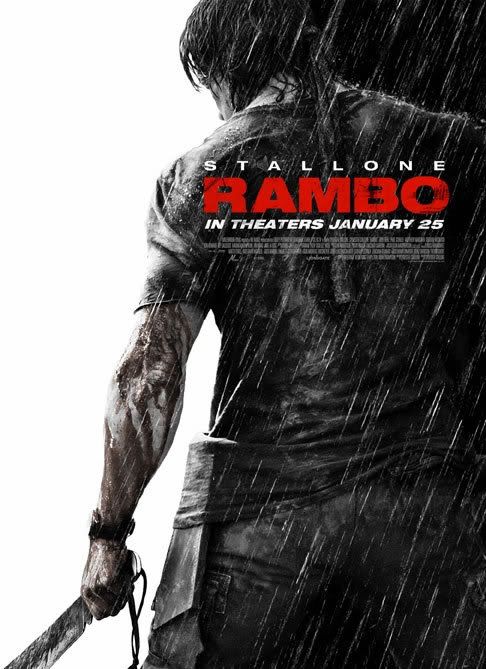
Review: Rambo

Get in, get out, no messing around.


As the rather contrived title of my review suggests, this film is rather like the mission which it portrays. It exists to serve one purpose: Deliver a level of (literally) visceral action we have not seen in 20 years.

There has rarely been a vessel better suited to this type of endeavour than Stallone as Rambo. Rambo has become the movies' definitive man of action over words. The history of the character (and of the actor playing him) imbue the entire film with the sense that once that low activation energy has been reached, a chain reaction is set in motion which cannot be stopped. Put a bee in Rambo's bonnet, and he doesn't so much shake it out as eat the fucking hat, bug and all.


Do not go in expecting a parable for modern American foreign policy, or any astute political observations on the Burmese situation. Do not expect award-worthy performances or dialogue. This film is here to punt your balls into your throat, and it does so with no mercy and no remorse.


The only reason it doesn't get 5 stars is because it's too damn short.

Friday, 18 February 2011

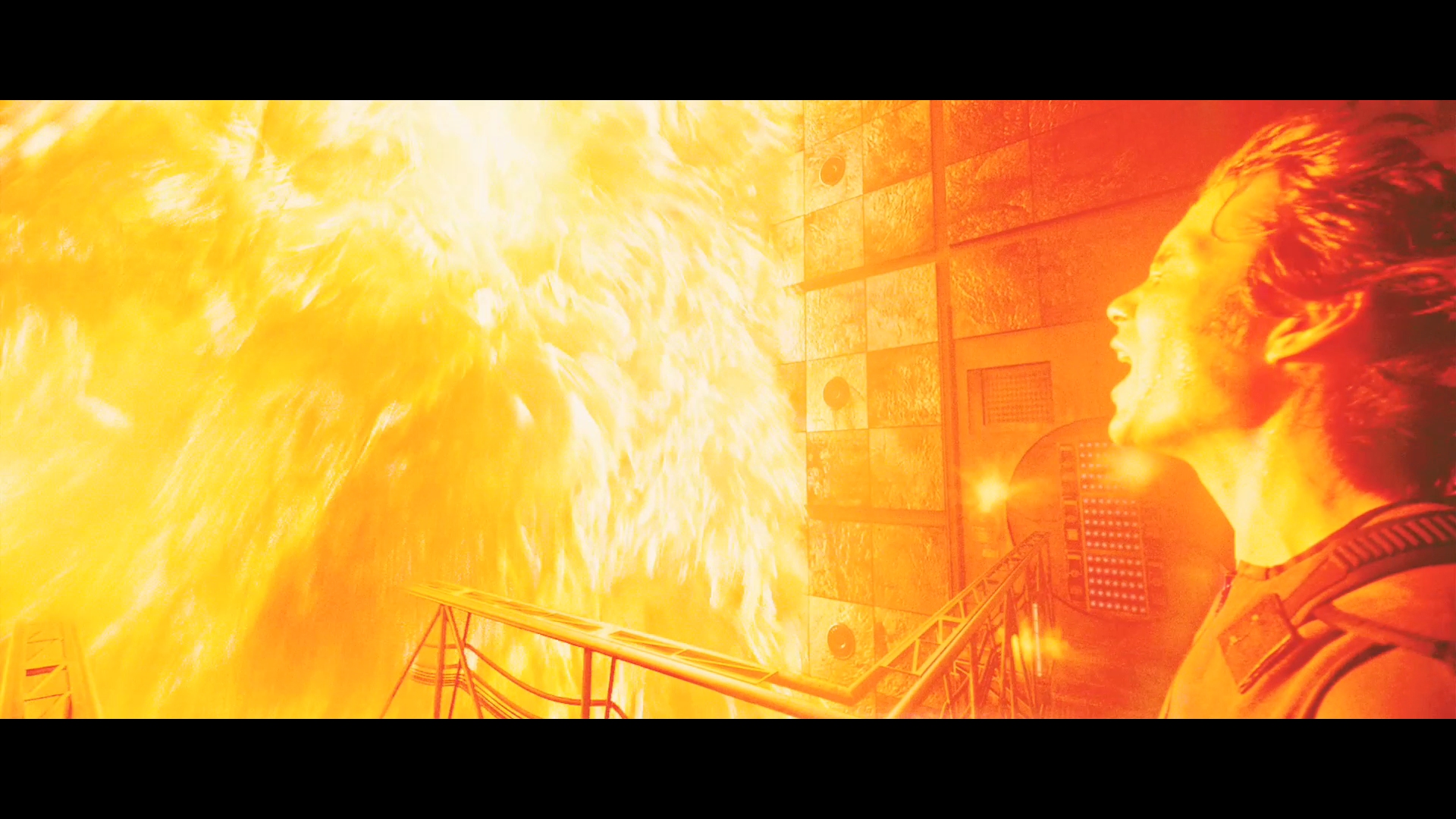
Review: Sunshine

Short version? 2001: A Space Odyssey meets Event Horizon.

I loathed Event Horizon, and I didn't particularly like the aspects of that film that Sunshine evokes either. But more later.

Long version? I quite liked most of it, but have some reservations.

The design, lighting and effects of this film are faultless, evoking Kubrick's 2001 quite loudly in places, as does some of the script. If this doesn't get nominated for best visual effects at next year's Oscars, I'll eat my montera.

The characterisation was a bit broad, but at least it was by and large believable. It was also great to see scientists portrayed as something other than social misfits, hermits or genii-on-the-edge. They (well, most of them) make life-or-death decisions with the clarity of judgment, coolness of approach and professionalism one would expect from the scientific crew selected to save the planet. The massive weight of responsibility on this mission (from an unseen Earth) affects almost every crewmember, and this creates is a tension remarkably well teased out through the entirety of the film. Remarkable because for 99% of the movie, you don't see the Earth at all.

There is no single standout performance because there is no clear lead, but I would have to say that Cillian Murphy is the one that left the slightest impression, which is surprising given the amount of screentime he has towards the end of the film. Chris Evans starts out with an unintentionally funny "Ron-Burgundy-on-the-skids" beard and mop, and he is quite unrecognisable until he shaves it off. Nonetheless, he puts in a solid, if typically alpha male, performance.

There were two actors whose performances perhaps wooed me more than the others, despite relatively brief screentime. The first was Cliff Curtis, as the officer with a toddler's quasi-spiritual desire to stare into the sun. The second was Hiroyuki Sanada as the dignified and measured Captain Kaneda, whose first thought is always for the mission, and then for his subordinates. There is a fantastically haunting moment between the two of them, which you will miss if you're not listening closely, just before the Captain parts ways with the rest of the crew.

Many people have started berating/defending the last act online already. This is the Event Horizon bit I was talking about earlier. Personally, I don't like it; it introduces an additional element of stalk-and-slash that lowers the otherwise intellectual tone of the film.


On the one hand, the "new element" is an extension of the spiritual theme introduced earlier in the film. On the other hand, it is not a natural extension of said theme, and it's a little stretched. It feels like an all-too-convenient plot device which reeks of laziness on Alex Garland's part, given how well the film was motoring through crises and deaths before the introduction of the "new element". I can think of a dozen ways for the third act to have followed a similar or identical arc without adding a "new element" so late in the game. Sure, it might have taken a bit of graft to get it to fit, but it can't have been a greater contrivance than what is there now. Furthermore, the "new element" has no part in the resolution, whether spiritually or emotionally; The way the film ends, the "new element" might as well not have been there.

A quick aside, if I may... I am glad to see that once again the British are once again getting to see British films before anyone else. Between Danny Boyle's movies, Children of Men and Edgar Wright's films, I no longer feel short-changed about our tax-dodging cousins getting to watch our films on the same day as we do, while we often have to wait months to watch theirs. The current trend for massive simultaneous rollouts for blockbusters on a global scale has gone some way to redressing the balance, but I am glad that we have something to gloat about over this side of the pond beyond the superior standard of most of our films.

Heh.

Review: Let The Right One In (Spoilers)

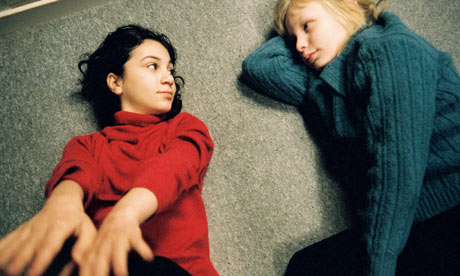
Oskar, a bullied 12-year old, dreams of revenge. He falls in love with Eli, a peculiar girl. She can't stand the sun or food and to come into a room she needs to be invited. Eli gives Oskar the strength to hit back but when he realizes that Eli needs to drink other people's blood to live he's faced with a choice. How much can love forgive? (from IMDb.com)

Review (***Spoilers***):

The title of "genre film" is a peculiar, treacherous mistress: Whatever genre the picture in question, by mere dint of the moniker, it will inevitably draw preconceptions. The very name means that it can be easily pigeonholed. Most genre films are therefore perceived as formulaic, low-brow examples of the cinematic form; a reassuring but unoriginal mix of thrills and chills, maybe some laughs, some possibly even unintentional. Indeed, most offer little more than a temporary distraction, devoid of original ideas and warranting no contemplation once the viewer has left the darkness of the screening room. Because of this prejudice amongst more "serious" filmgoers, few movies are better placed to confound expectation than genre films, especially those in the harder genres, such as horror.


Let The Right One In is just such a film. Right from the stark white, small, block capitalised title cards, it is clear that this is something other than a compendium of cheap parlour tricks. It is also uniquely, unmistakeably Swedish. It does not open with a jolting scare or kill, as might be usual for the genre, but rather with a measured and near wordless introduction to our two leads: the gawky, awkward Oskar, who harbours a disturbing fantasy of violence which runs counter to his innocence, and the sickly Eli, rendered intriguing by the nature of her relationship with Håkan, her guardian.

The film does come to its first kill in short order. An almost casually efficient setup at home leads into an objectively shot scene of a simple, methodical bloodletting. Alfredson maintains this non-judgmental, "stand back and watch" approach to violence throughout the film. As a result, all of these scenes serve the story and advance the characters, rather than pandering to any trivial concepts of right and wrong or good vs. bad.

In this first instance, the killer is all too human, and when unable to handle interruption by a not remotely threatening poodle (he ineffectually throws a handful of snow at it and tells it to "shoo"), he quickly gathers most of the essential tools and flees before the dog's owners reach the grisly aftermath. The scene closes with the dog lapping up the spilt blood, and with that Let The Right One In has set out its stall: This is a film which defies the usual trappings of the vampire film: the life of a bloodsucker is not glamourous, but grounded in a world of disgust, social exclusion and remorse.

This first murder also reveals two of the film's greatest tools: a fantastic score and truly Oscar-worthy sound design. The composer, Johan Söderqvist, makes sparse but effective use of piano and strings, resulting in a soundtrack which is equally haunting and moving. By opting to show little by way of stunts or gore in the movie (except for a few standout prosthetic appliances), Alfredson allows sound to become a key player in the storytelling.  He uses it to phenomenal effect, whether it be a perfectly timed lorry thundering overhead as tension rises beneath a bridge, or feeling the sting of birch on flesh as Oskar is dealt the swipe of a cane by his bullies.

This in turn means that the audience is incited to indulge their own imagination, a concession rarely afforded in the modern climate. Most studio filmmakers these days have the arrogance to assume either that our creative minds aren't up to much, or that their CG-addled visions are more powerful than our own, private ideas of horror/magnificence/extasy/etc. It is therefore gratifying and immediately endearing to watch a film which encourages us, the audience, to fill in the blanks for ourselves. Even the infamously violent swimming pool scene is remarkable for its visual restraint and composure (and also its witty reversal of Jaws' opening gambit): the muffled sounds of what is happening above water and fleeting glimpses of the carnage tell us all we need to know, our imagination telling us what we would probably do better not to.

let-the-right-one-in-2.jpg (800×344)

Much has been made of the two central performaces by the kids. Certainly, these are very strong, but given the spartan emotional style and stereotypically Scandinavian bleakness (if you saw the Wallander TV series over the winter, you'll have an idea of the tone), one is left wondering if perhaps the minimalist performances are a directorial result of the children's obvious lack of acting experience. Very sensibly, Alfredson never asks too much of either of his leads.

That is not to say that this film is devoid of emotional content, however. Far from it, this film speaks centrally of the most powerful of all the emotions: Love. And not just the joyous promise of romantic love discovered, as the young Oskar finds with Eli, but love in all its forms, whether unrequited, mutual, or lost: The brotherly love shared by two men coming home from the bar, soon to be rended by death, which the tragic figure of the wife cannot replace; The inevitable sadness of the love of partners unilaterally expired, leaving the love of a disciple, as that of Håkan for his ward Eli, who is demonstrably willing to give up absolutely everything for her; The love of a parent for their children, notable chiefly for its near absence from Oskar's life.

So we come to realise that the title may not solely allude to the old convention that, on pain of death, a vampire can only enter a home when invited. Alfredson might also be telling us, in fittingly Swedish guardedness, that we should be careful to whom we open our hearts, for the wrong one might just ruin them.